

A Homecoming Exhibition from Japan Pavilion of the 60th Venice Biennale
Yuko Mohri participated in the 2024 Venice Biennale as a representative of Japan, and held a solo exhibition titled "Compose" at the Japan Pavilion under the commission of the Japan Foundation and curated by Sook-Kyung Lee.
This year sees the exhibition making a triumphant homecoming to Yokohama.
Mohri is renowned for installations that employ everyday items, natural materials, and other devices to create irregular movement, light, and noise. Her humor-tinged works express often overlooked natural laws related to the ubiquity of energy, and invisible connections and cycles between things.
The exhibition’s title at the Venice Biennale, “Compose,” suggests both musical composition and structural assembly, and has etymological roots in the Latin com (together) and pose (to place).
Mohri has long based her practice around relationships between things and the forces those relationships set in motion. Here she turns to a world fractured at every level, from the pandemic to ongoing conflicts in many parts of the world, and asks what it means to coexist and share a life with others.
The exhibition brings together two ongoing series. "Moré Moré (Leaky)," now over a decade in the making, is inspired by the chronic water leaks that plague Tokyo’s subway stations and the makeshift repairs improvised by station staff with whatever is at hand. Mohri applies the spirit of these fixes to installations of everyday objects that form impromptu systems of water circulation. "Decomposition," the second series, centers on fruit: electrodes inserted into the fruit register changes in moisture as it slowly decays, generating irregular sound and light in response. Water is the connecting thread, and both groups of works render its cycles and transformations visible. Light, sound, and scent fill the space, and together they engage the senses with quiet intensity.
Don’t miss this special opportunity to experience Mohri’s “recomposition” of the Venice exhibition.
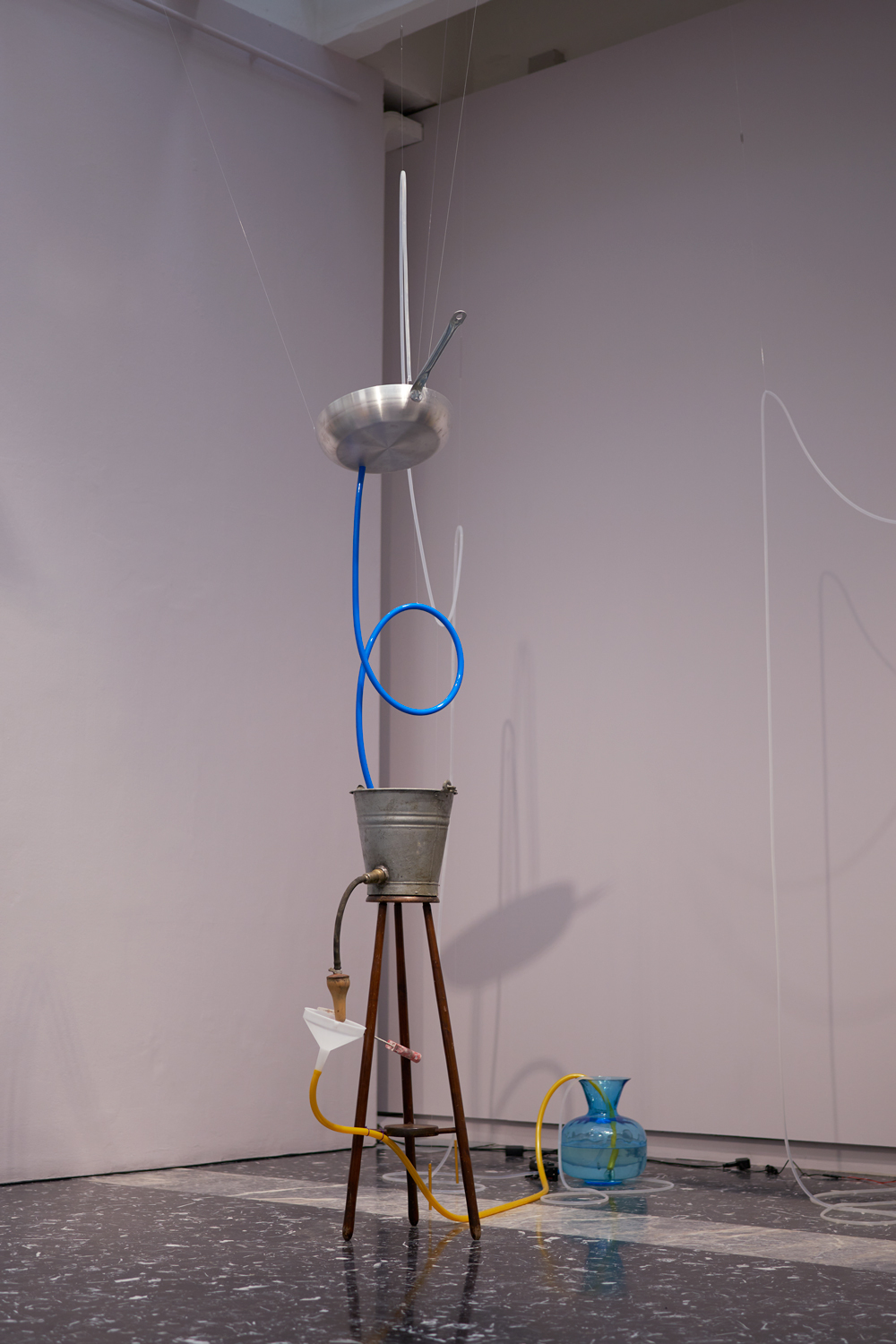
"Moré Moré [Leaky]"
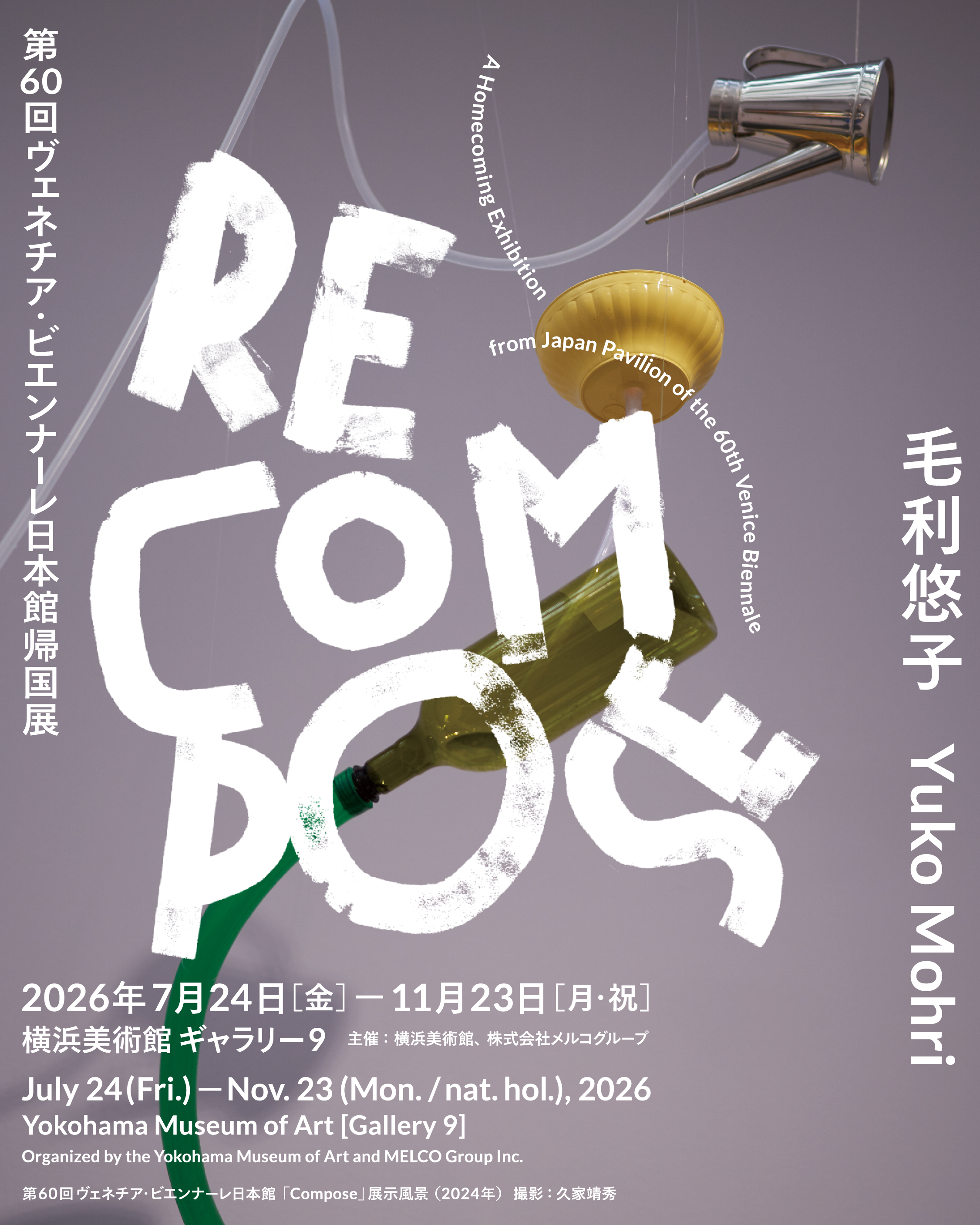
This sculpture series is inspired by the chronic water leaks throughout Tokyo’s subway stations and the makeshift repairs station staff improvise with whatever tools come to hand. A remarkable variety of everyday objects come together as impromptu systems of water circulation.
Photo: kugeyasuhide
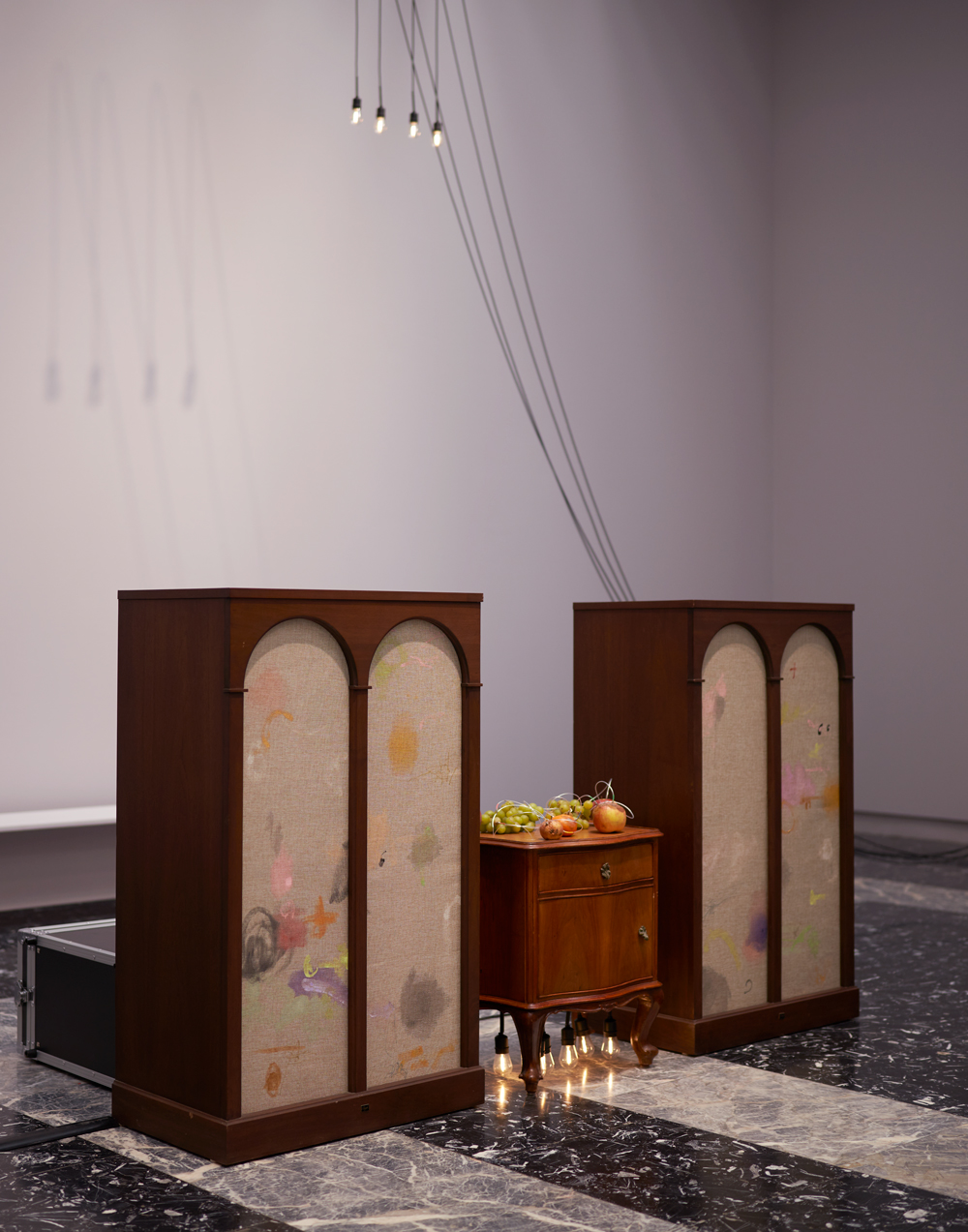
"Decomposition"
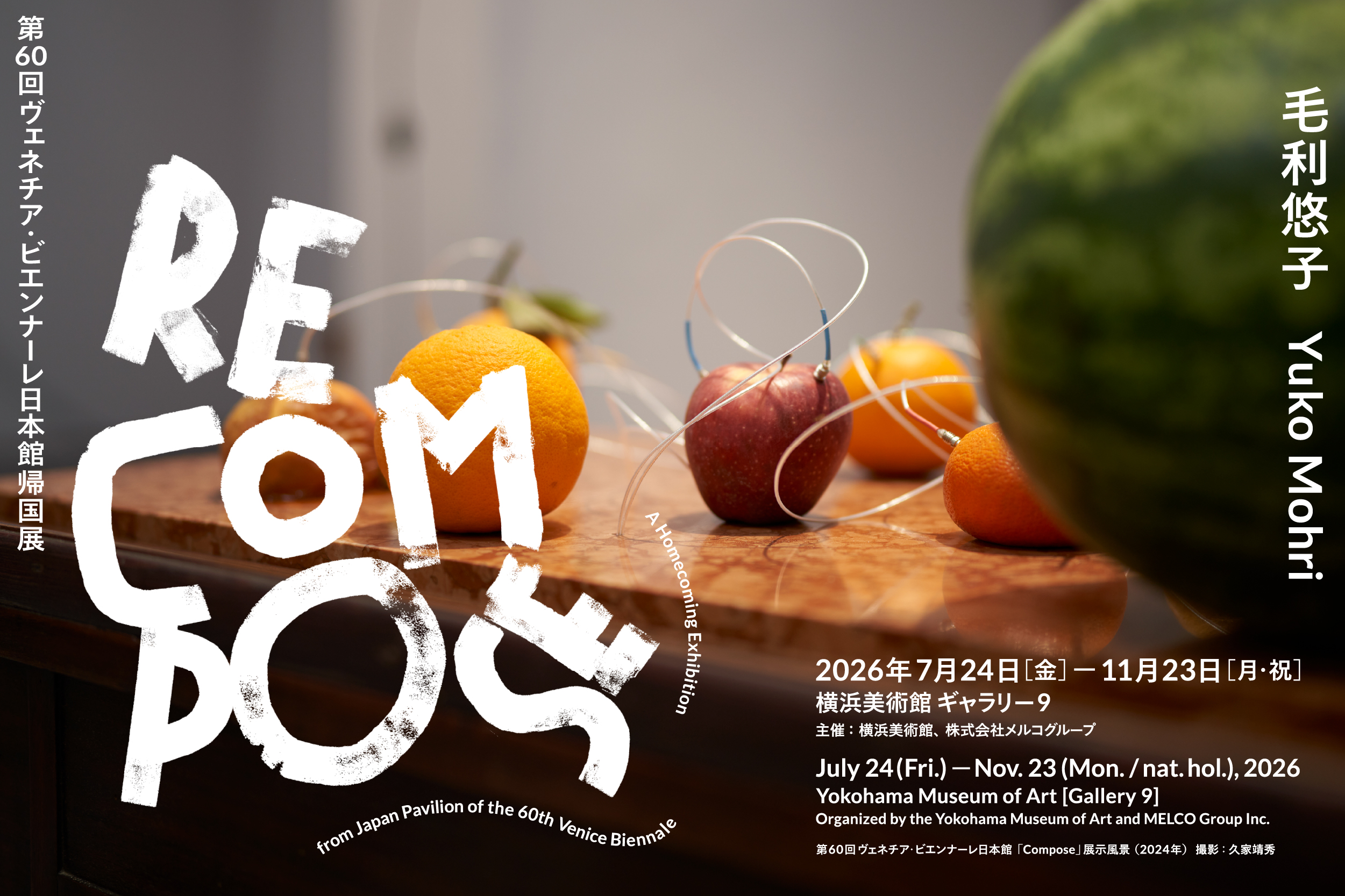
Various fruits set out on a table decay slowly over time. Electrodes inserted into them register the shifting levels of moisture inside, generating irregular sound and flickering light in response.
Photo: kugeyasuhide
The 2024 Venice Biennale closed on November 24 of that year, but “Compose,” my exhibition at the Japan Pavilion, in fact continued afterward. Even after the works incorporating everyday objects and furniture had been cleared away, the enormous compost bin displayed under the pilotis remained in place for some time. This was because the more than 400 pieces of fruit used over the six-month run needed several more months to decompose fully. At the end of March 2025, the matured compost was at last spread beneath the ramp between the Japan Pavilion and the Korean Pavilion, and over the garden in front of the German Pavilion.
The fruit used in the exhibition was kindly provided by a greengrocer a short walk from the Giardini, where the exhibition was held. I had heard that fruit displayed outdoors, once past its best, was simply thrown away. Margherita, who was a gallery attendant and guide during the exhibition, continued visiting the shop to obtain fruit for the installation after I returned to Japan, and she still exchanges greetings with the grocer now that the exhibition is over. She told me this the other day, when I visited Venice for the first time in a long while. (For this I am truly grateful.)
With a title whose etymological roots mean “together” (com) and “to place, to arrange” (pose), “Compose” sought to engage with the objects I gathered in Venice, the people who became involved in the process, and the local environment itself. Over the two months leading up to the opening, the space took shape improvisationally, through repeated mending and repairing on site. It was presented “for the time being” at the opening, but that was never meant to be the end point, and the work continued to recompose itself afterward.
Now, in 2026, the installation, transported from Venice to Japan and kept in storage for a time, is being recomposed in the glass-walled gallery of the Yokohama Museum of Art. In a different country, responding to the rhythms of another environment, it will no doubt change into a new form once again.
Over these past two years, our society too has changed a great deal. Overwhelming external forces, including war and the climate crisis, continue to disrupt the conditions of our lives. And yet, among the things placed here together, resisting and interfering with one another, uncertain connections are woven again and again, and it is these that I hope to keep sensing through this work.
1. Exhibition that drew acclaim at the Venice Biennale, presented in Japan for the first time two years on
Yuko Mohri has made remarkable strides on the global art stage. Her solo exhibition “Compose,” which was presented in the Japan Pavilion at the 2024 Venice Biennale, generated a great deal of buzz through coverage in The New York Times and other international media outlets. Returning exhibitions from the Japan Pavilion at the Venice Biennale typically travel to the Artizon Museum in Tokyo, but this one finds a new venue at the Yokohama Museum of Art, in Mohri’s home prefecture of Kanagawa. With water as their central motif, her works pass the baton from one aqua metropolis to another: Venice to Yokohama.
2. Inaugural exhibition in the newly built glass-walled gallery
Gallery 9, the venue for this exhibition, is a glass-walled space added during the museum’s recent renovation. Mohri’s work draws connections between art and the rhythms of nature and daily life, making visible the unexpected shifts and quiet transformations that run through all things. The gallery is designed to open onto the shifting light and scenery of the Art Plaza outside, and the affinity between Mohri’s installations and this responsive space brings out the full potential of the new venue.
【Excerpt from “Curator’s note” for "Yuko Mohri: Compose at Japan Pavilion at the 60th International Art Exhibition – La Biennale di Venezia"】
With a title that etymologically signifies “to place together (com+pose)”, the exhibition asks what it means for people to be and work together in a world challenged by division, conflicts, and multiple global crises. Mohri observes how crises bring out the greatest creativity in people – this is the primary idea behind Mohri’s project, initially inspired by the Tokyo subway personnel’s resourceful measures against water leaks. The water leaks are never fully fixed, and the fruits end up in the compost to rot in Mohri’s installation, but these apparently futile endeavors indicate a glimpse of the hope that our humble creativity might bring about.
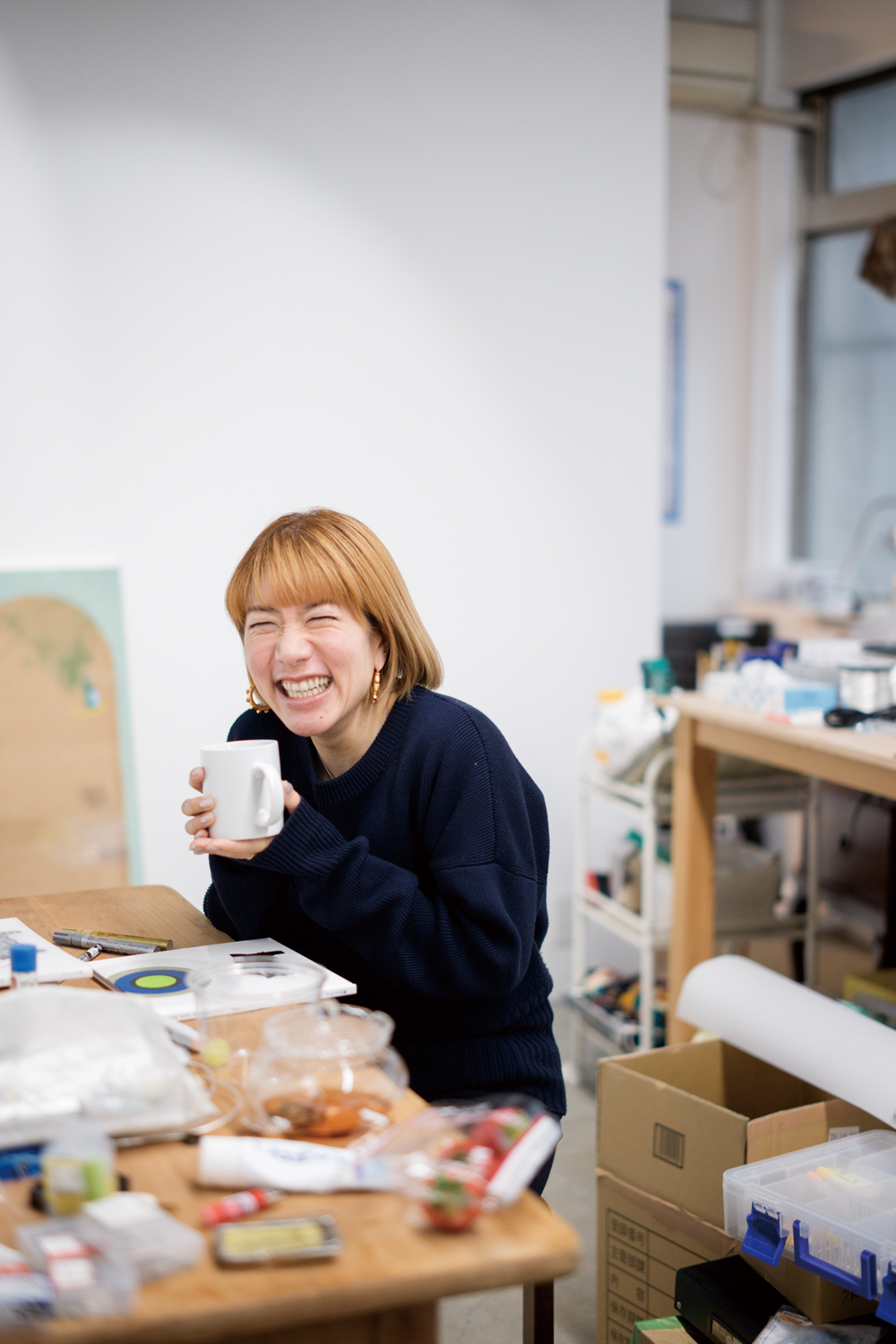
Born in 1980, Kanagawa. Mohri assembles readymade objects, found objects, and self-built devices into installations and sculptures concerned less with formal construction than with events that shift in response to environmental and other conditions. Energy from electronic circuits ripples through the composition of each work and reaches the viewer through sight, sound, and at times touch, conveying fragments of the unpredictable phenomena of daily life and of the complexity latent in the larger structures of the world.
●Recent exhibitions (selected)
Solo exhibitions
Entanglements (Pirelli HangarBicocca, Milan, 2025/Centro Botín, Santander, 2026)
Piano Solo: 12th January, 1900 (National Museum of Modern and Contemporary Art, Seoul, 2025)
Jam Session: The Ishibashi Foundation Collection × MOHRI Yuko – On Physis (Artizon Museum, Tokyo, 2024)
Moré and Moré (Aranya Art Center, Qinhuangdao, 2024)
International exhibitions
The 60th International Art Exhibition – La Biennale di Venezia (Venice, 2024)
The 14th Gwangju Biennale (Gwangju, 2023)
The 23rd Sidney Biennale (Sydney, 2022)
The 34th São Paulo Biennale (São Paulo, 2021)
●Awards
Grand Prix, Nissan Art Award 2015 (2015)
Culture and Future Prize, the 65th Kanagawa Culture Award (2016)
The New Face Award, the 67th Minister of Education Award for Fine Arts, Japan (2017)
Calder Prize (2026)


