

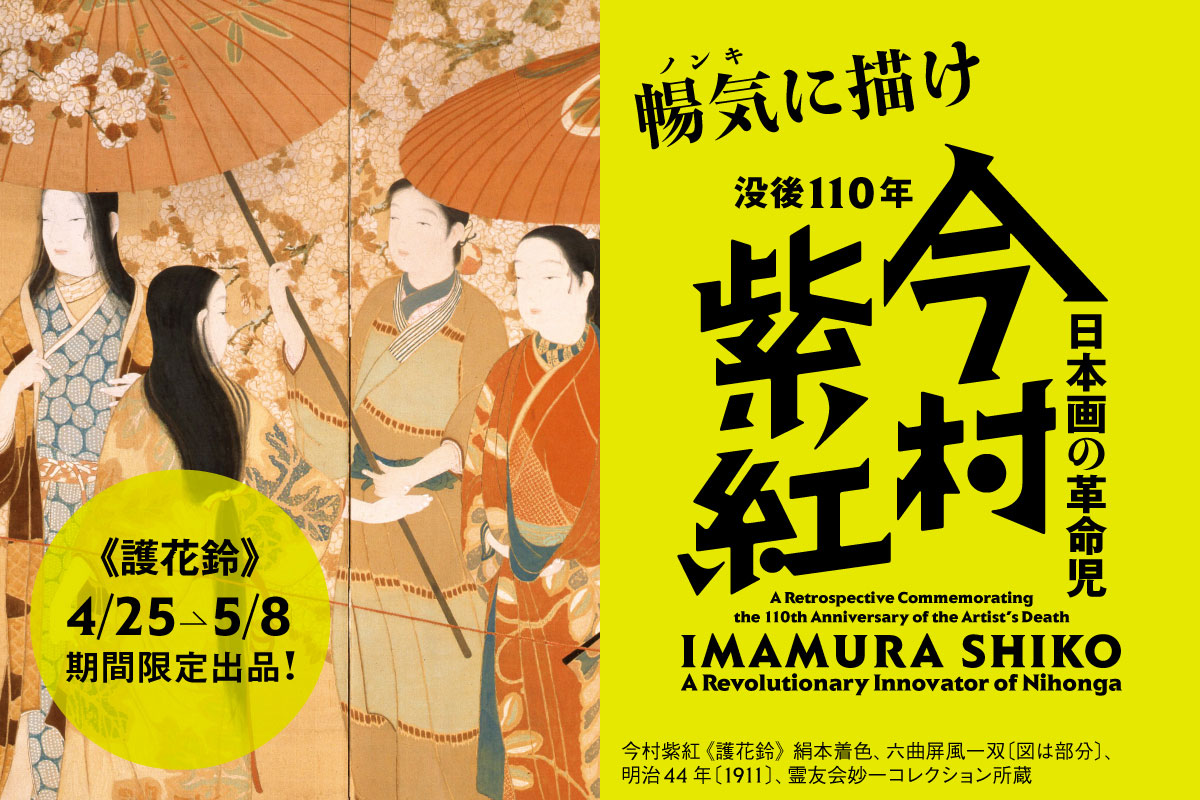

A Retrospective Commemorating the 110th Anniversary of the Artist’s Death
The painter Imamura Shiko (1880–1916) was active from the late Meiji era (1868–1912) through the early Taisho era (1912–1926). This is the first large-scale retrospective of his work in 42 years, and the first ever to be held at a public art museum. Shiko studied traditional Yamato-e, a Japanese painting style established during the Heian era (794–1185) and practiced continuously since, and at a young age demonstrated exceptional skill in history painting. He later set his sights on innovation in Nihonga (modern Japanese-style painting). Drawing inspiration from 17th-century Rimpa painters, particularly Tawaraya Sotatsu’s free and fluid style, he also incorporated elements from Nanga (a style of Japanese landscape painting established in the mid-18th century and influenced by works from China’s Jiangnan region) and Western Impressionism, developing a distinctive approach to landscape painting. His deliberate and determined brushwork, bold compositions, and vivid colors are exemplified in works such as “Scenes from the Tropics” and “Eight Views of Omi Province” (National Important Cultural Properties). This exhibition follows Imamura Shiko’s dynamic creative path over the course of his brief 35 years, presenting approximately 180 works, many on public display for the first time. The exhibition consists of four sections, whose titles are taken from Shiko’s own words.
Section 1: “After taking apart the best parts of the classics, follow their lead!”
Section 2: “Paint in many different ways!”
-1 Meeting Hara Sankei
-2 Shiko and the Rimpa School
Section 3: “Both freedom and innovation are mine alone!”
Section 4: “Paint without a care!”
1. The First Imamura Shiko Exhibition in 42 years, and the First Ever at a Public Museum
This marks the first major solo exhibition of work by Imamura Shiko since the 1984 retrospective held at the Yamatane Museum of Art.
2. The Most Definitive and Comprehensive Exhibition of the Artist’s Work
The exhibition provides a rare opportunity to see approximately 180 of Imamura Shiko’s most important and rare paintings, including National Important Cultural Properties, assembled in one place.
3. Never Before Shown Works from Private Collections
Some 40 works by Imamura Shiko from private collections are being presented here for the first time.
Section 1: “After taking apart the best parts of the classics, follow their lead!”
Born in 1880 to a Japanese lantern wholesaler in Yokohama, Imamura Shiko moved to Tokyo at the age of 17 and became an apprentice to Matsumoto Fuko, a master of history painting. Shiko began his formal training in Nihonga by meticulously copying “funpon” (a collection of sketches for learning classical motifs and techniques), and diligently practicing outdoor sketching in the suburbs. He soon distinguished himself in the field of history painting, receiving commendations in exhibitions organized by the newly established Nihon Bijutsu-in (Japan Art Institute). This section traces Shiko’s early quest to explore new horizons in history painting while absorbing “the best parts of the classics” through the use of “funpon” and other techniques.
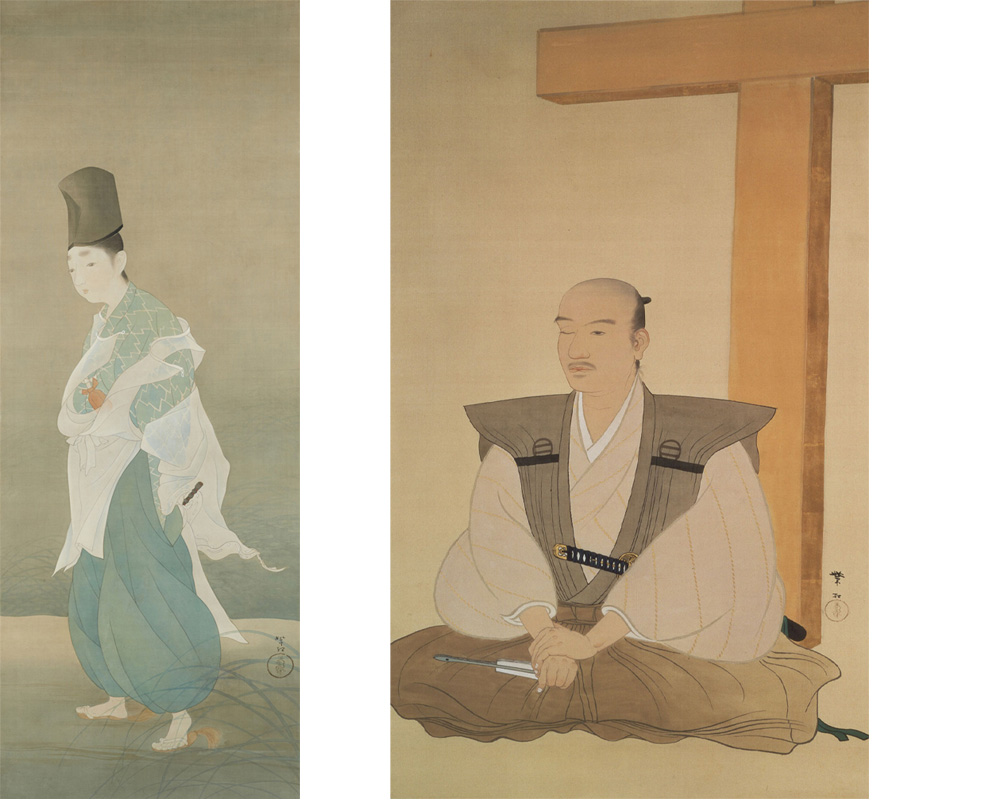
Left: “Flute”, Color on silk, Hanging scroll, c.1900, 107.8×40.5 cm,
The National Museum of Modern Art, Tokyo
Right: “Portrait of Date Masamune”, Color on silk, Hanging scroll, 1910, 120.5×71.0 cm, Yokohama Museum of Art
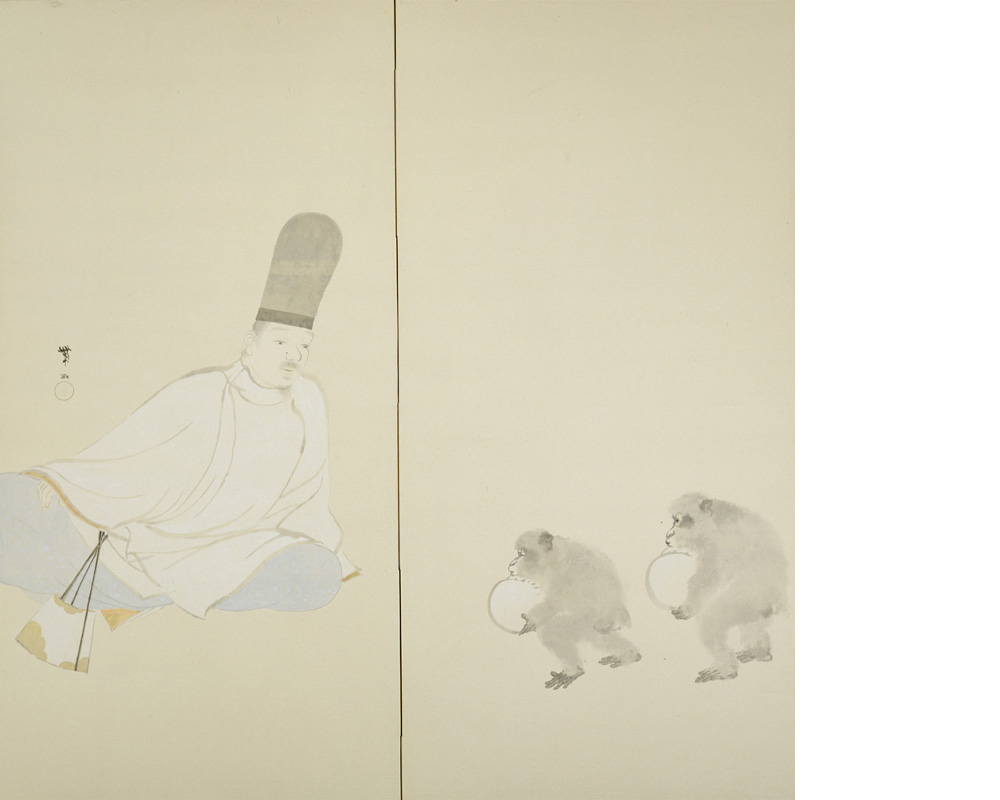
“Fujiwara no Narimichi, Talented Player of Kemari (Ancient Imperial Football Game)”, Color on paper, Two panels folding screen, 1911, 147.4×145.6 cm,
Yokohama Museum of Art
Section 2: “Paint in many different ways!”
2-1: Meeting Hara Sankei
2-2: Shiko and the Rimpa School
As a promising young member of the Nihon Bijutsu-in (Japan Art Institute), Shiko was deeply inspired by the teachings of the institute’s founder Okakura Tenshin, and the works of painters such as Yokoyama Taikan, Shimomura Kanzan, and Hishida Shunso. He focused on pioneering Rimpa school artists such as Tawaraya Sotatsu as well as classical paintings from the Chinese Ming and Qing dynasties to broaden his creative scope. At the Bunten exhibition, his work “Gokarei (Bird Repelling Bell),” a 16th-century Momoyama-themed piece, caught the eye of an influential Yokohama businessman named Hara Sankei. An admirer of Momoyama culture, Sankei subsequently became Shiko’s patron. This section examines how Shiko came to discern the essence of classical painting, and master a wide range of subjects and genres by “painting in many different ways” after becoming financially stable with Sankei’s support.
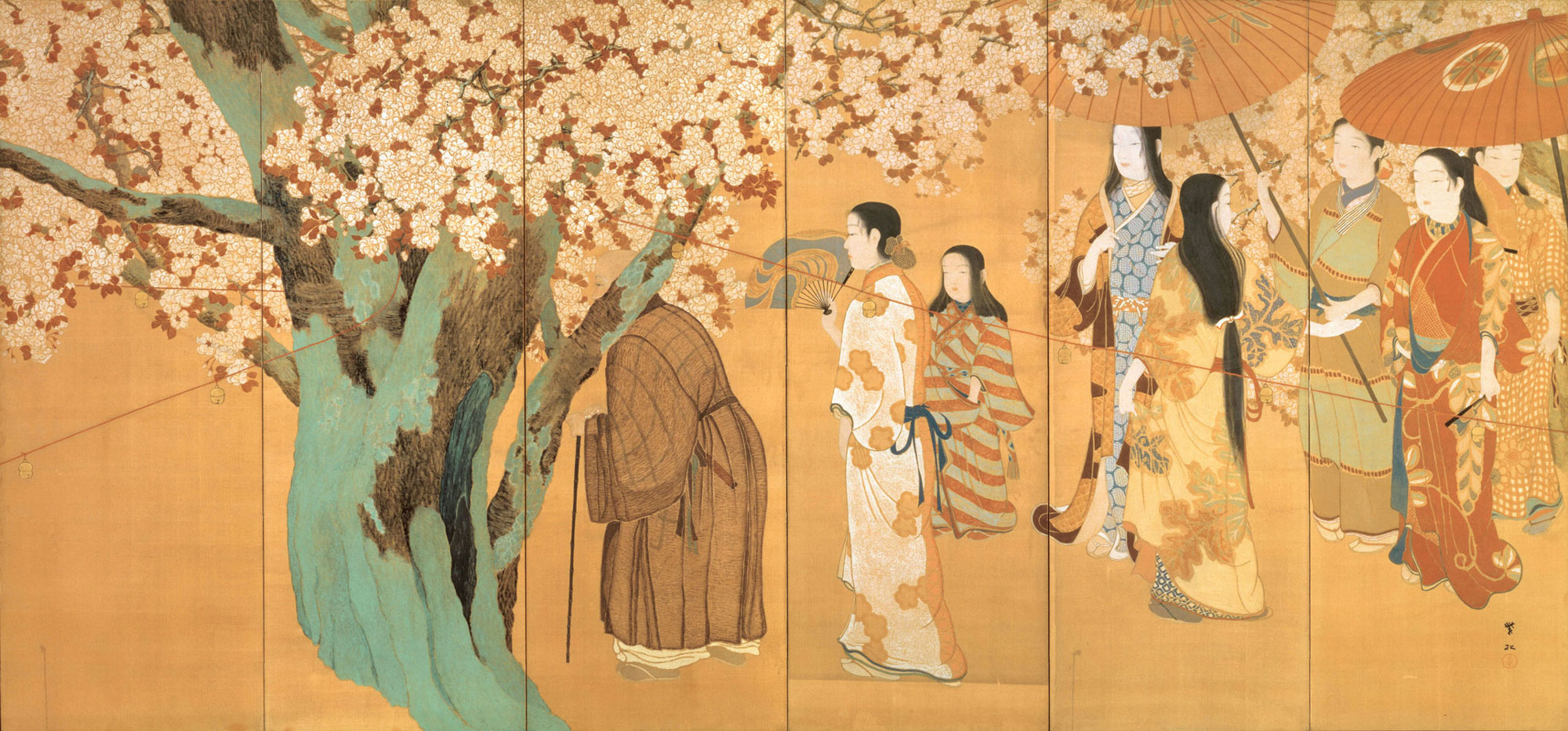
“Gokarei (Bird Repelling Bell)” (right screen), Color on silk, A pair of six panels folding screens, 1911, 170.2×364.4 cm (each),
Rei-yu-kai Myoichi Collection (On display from April 25th to May 8th)
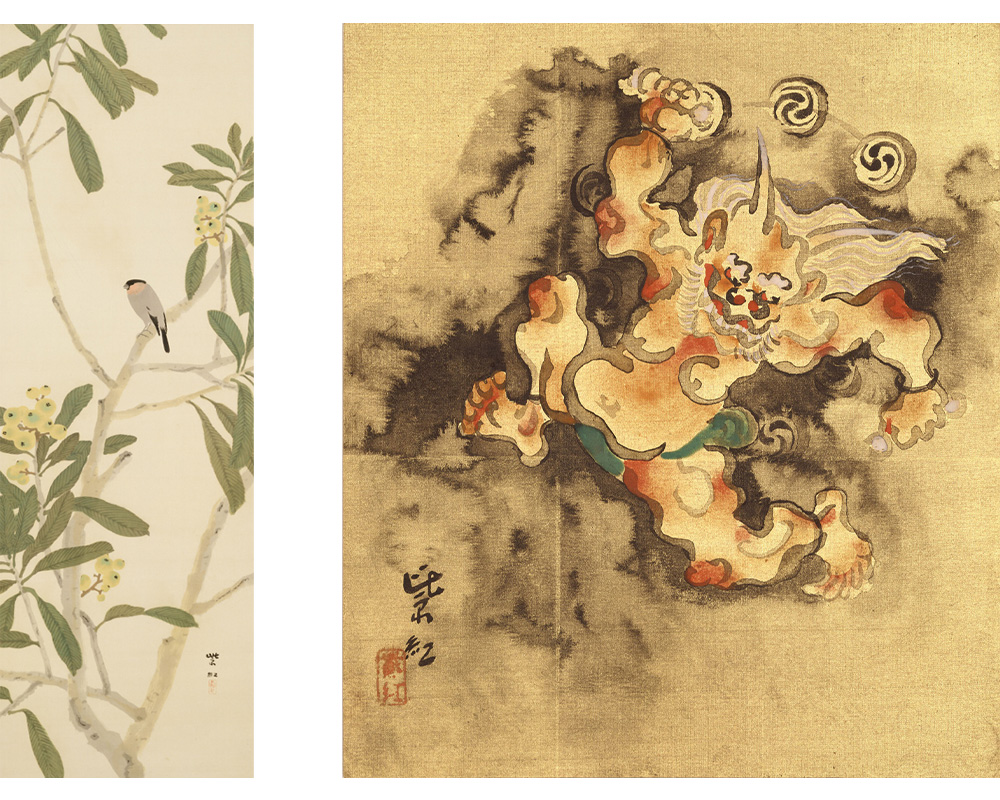
Left: “Bullfinch in a Loquat”, Color on silk, Hanging scroll, 1913, 121.2×41.3 cm,
Yokohama Museum of Art
Right: “Thunder God”, Color on gold-foil paper, Shikishi cardboard, 1916, 21.0×18.0 cm, YAMAGUCHI HOSHUN MEMORIAL MUSEUM
Section 3: “Both freedom and innovation are mine alone!”
Having achieved financial stability, Shiko began working on a series called “Eight Views of Omi Province,” which proved to be a turning point in his career. He traveled around the Omi area, located near Lake Biwa in Shiga Prefecture, a popular subject in “meisho-e” (paintings of famous scenic places) since ancient times, and created eight landscape paintings based on his nature sketches. The limpid colors and compositions are a reflection of Shiko’s spontaneous state of mind, unrestrained by the conventions of classical landscape painting. In an effort to pursue new challenges, he embarked on a journey to India the year after next despite not having fully recovered from an illness at the time. After returning from the trip, Shiko showed “Scenes from the Tropics,” a pair of scroll paintings depicting the places he had visited. The provocative works later created a stir for breaking the boundaries of Nihonga. This section focuses on Shiko’s bold challenges as exemplified by his comment that “both freedom and innovation are mine alone.”
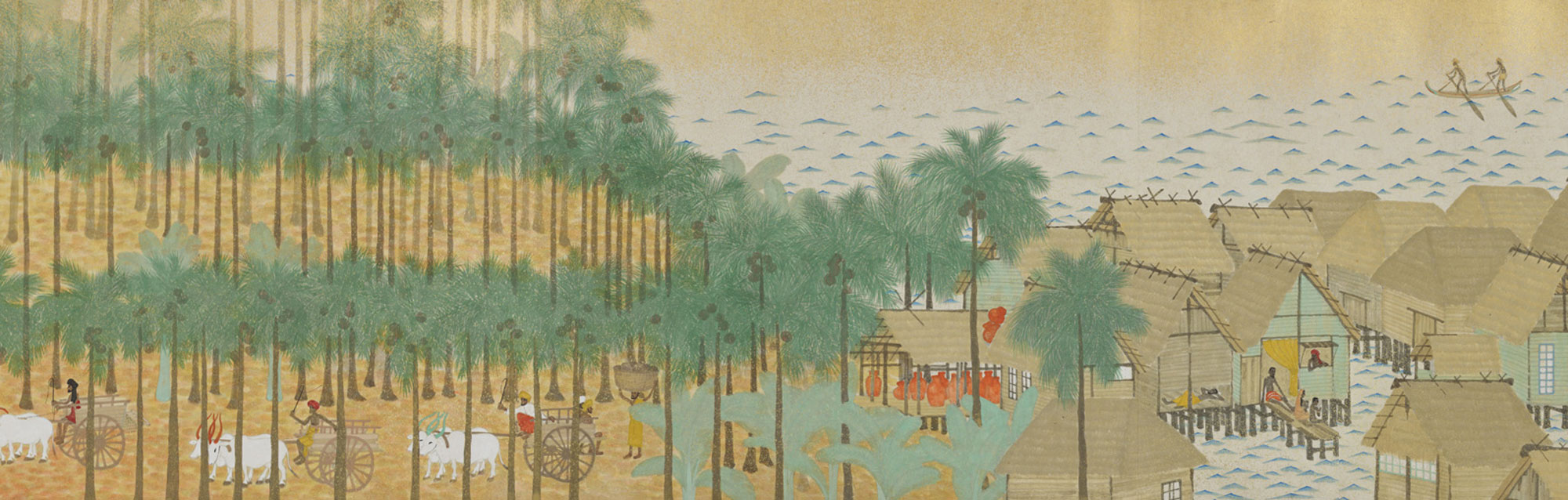
"Scenes from the Tropics: Morning" (detail), Color on paper, Scroll, 1914, 45.7×954.5 cm,
Tokyo National Museum *National Important Cultural Property (On display from April 25th to May 20th)
*"Scenes from the Tropics: Evening" will be on display from May 22nd to June 3rd.
Image: TNM Image Archives
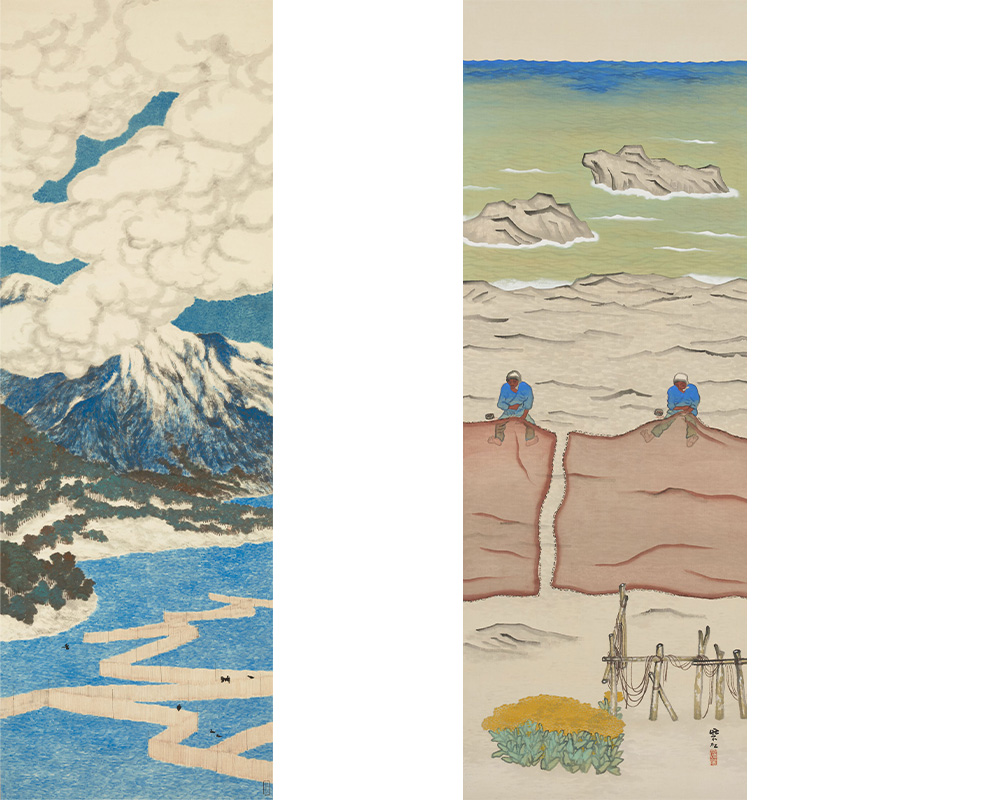
Left: “Mt. Hira” from “The Eight Views of Omi Province”, Color on paper, from the set of eight hanging scrolls, 1912, 165.0×56.9 cm(each),
Tokyo National Museum *National Important Cultural Property (On display from June 5th to June 28th)
Image: TNM Image Archives
Right: “Spring Sea”, Color on silk, Hanging scroll, c.1914, 139.6×50.3 cm
Section 4: “Paint without a care!”
As a central figure at the Saiko-Nihon Bijutsu-in (Revival Japan Art Institute), Shiko served as a guide for his colleagues, and dedicated himself to making innovative Nihonga. He envisioned an environment in which young painters, free from financial concerns, could explore art with a lively and unconstrained spirit – i.e., a place where they could “paint without a care.” One example of this was Shiko’s decision to form the Sekiyo-kai research group with his colleagues. At the same time, he reevaluated and absorbed the influence of Edo-era Nanga (“Southern painting”), which had come to be seen as antiquated, leading him to develop a new style that might be described as “Shin-Nanga” (“New Southern painting”). Shiko found the vibrant Nanga works of painters such as Ike no Taiga and Tomioka Tessai deeply compelling, and delved into researching the Ming and Qing dynasty paintings that had spurred on the artists. The influence of contemporary Western painting is also apparent in Shiko’s works of this era. This section explores the deepening of Shiko’s artistic vision, which grew increasingly refined in his later years.

Left: “Southern Wind”, Color on silk, Hanging scroll, 1915, 111.0×41.4 cm
Right: “Peach Blossom Land”, Color on silk, Hanging scroll, 1916, 141.3×56.3 cm
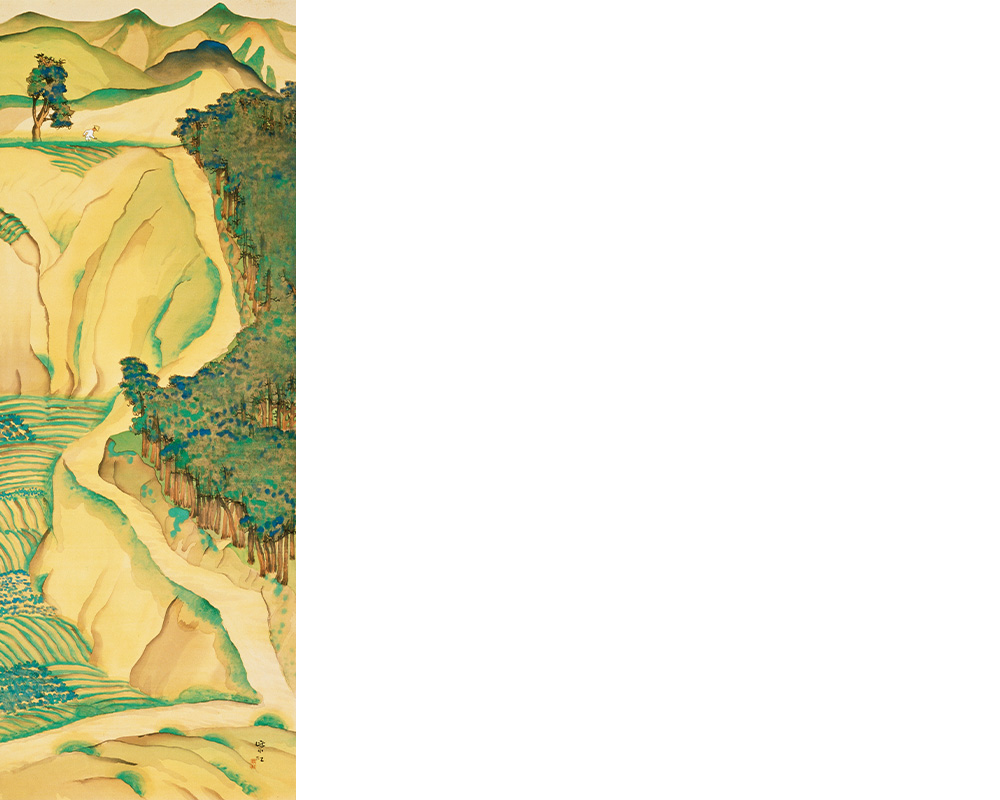
“Shiomizaka Slope”, Color on silk, Hanging scroll, 1915, 112.5×42.0 cm, Yokohama Museum of Art
Fluffy Charms: a Lucky Bird, Uso (Bullfinch) and a Monkey Holding a Kemari Ball
Inspired by the designs “Bullfinch in a Loquat” and “Fujiwara no Narimichi, Talented Player of Kemari,” these charming animals have been turned into soft, round plush toys. Attach them to your bag and take them with you wherever you go.
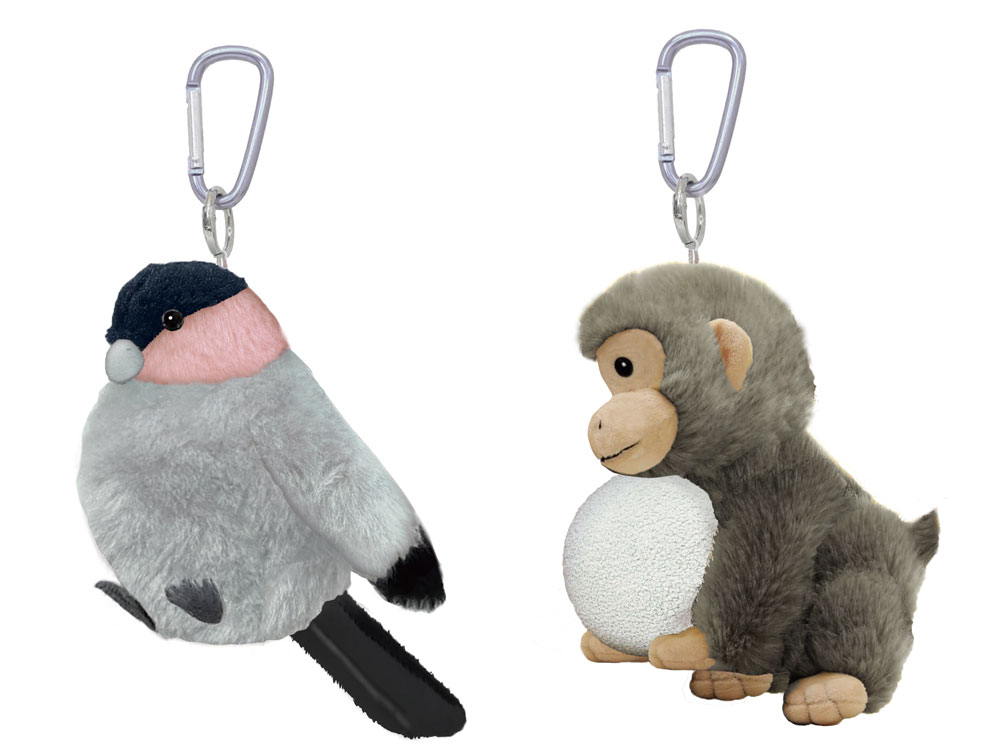
Price: ¥2,200 each (tax included)
*1 (Advance ticket price / Discounted price for group of 20 or more)
・ All prices include tax.
・ For a group of 20 or more, reservation is required in advance.
・ Advance tickets are available at the Museum Shop from January 13 to April 24 and also via online from 11:00 on January 13 until 23:59 on April 24 at ARTPASS, Online Ticket(e-tix), Asoview!(Japanese only), and Seven-Eleven Ticket(Japanese only).
・ Visitors with disabilities and one caregiver accompanying them are admitted free of charge (Please present a certificate at the entrance).
・ The ticket also grants admission to the Collection Exhibition on the same day.


